
A review of the Tangara Open Hardware Hacker iPod Clone
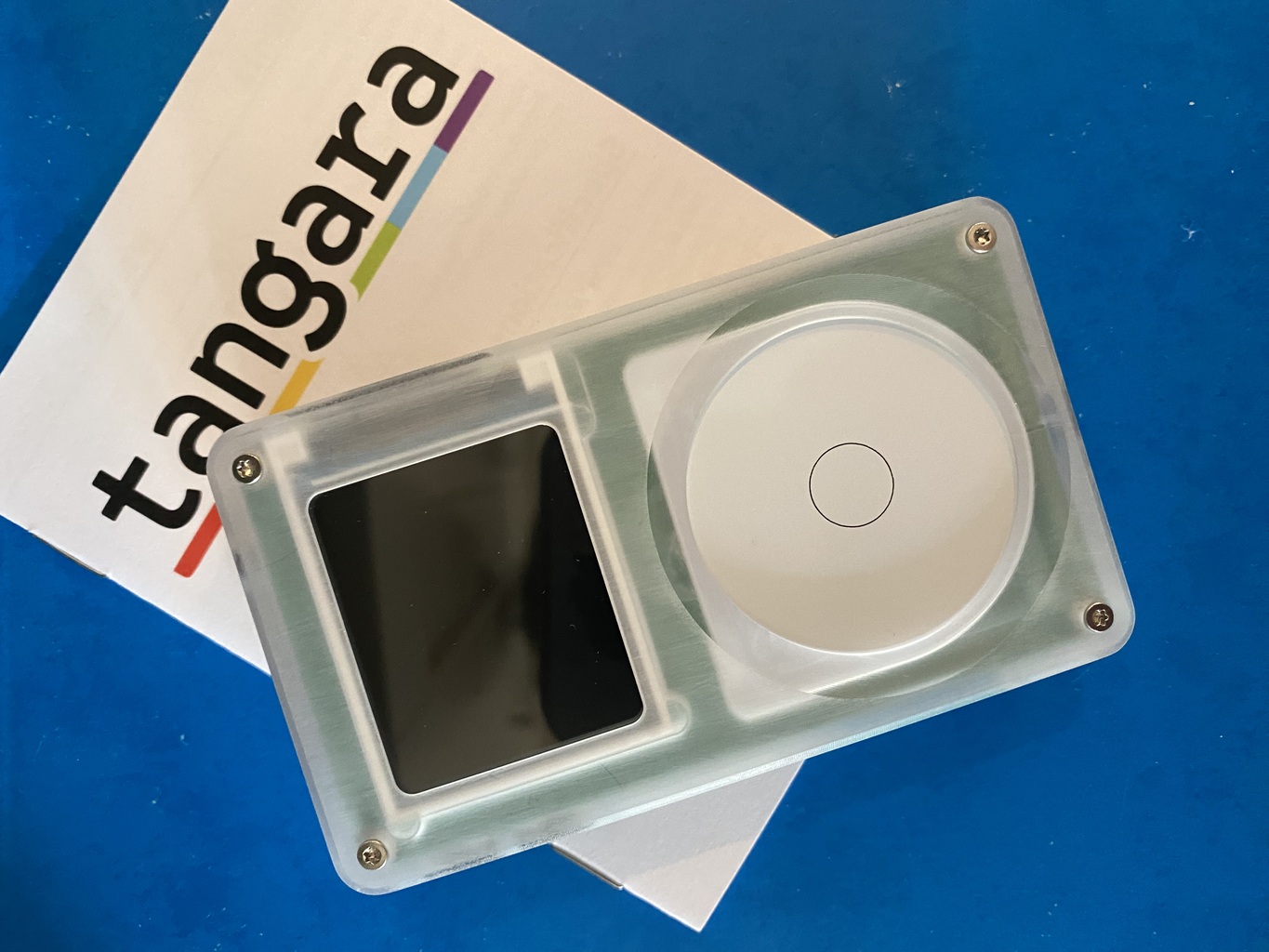
I preordered a Tangara music player from CrowdSupply in October 2024. It arrived in April 2025, and I used it on and off until I sold it as defective on Swedish EBay this February, 2026, for 770 SEK, about 25% of what I paid for the device.
I had pretty much the same experience I’ve had with every piece of open source hardware starting with the OpenMoko Neo Freerunner, with the notable exception of the Flipper Zero, from the original crowdfunding campaign, which has served me well and still does. In other words, I bought a thing that wasn’t finished and probably never will be. That said, the Tangara is probably a distant second best experience.
Why I bought it
In stark contrast to the Neo Freerunner 17 years ago, I knew what I was in for with this device. Sort of. I knew I was buying something that would likely need some hand holding, and fully expected to have to wait for some features and work at some others. In fact, I figured it might be fun to hack on the project and shape its development. I wanted a portable music player for the same reason everyone else does these days, that is to:
- get away from every feature of your digital life being on a device broadly designed for communications.
- reduce my reliance on the Apple echo system, which was (and still is) increasingly pricing me out.
- try a different way of experiencing music listening.
- lower my reliance on subscription services that are only hiking their prices for worse and worse offerings.
- do the [[Walkaway]] thing and participate in something that isn’t from a Big Corporation that also has some vague promises of being maintainable and repairable.
- in particular, disaggregate the device from the storage of the device, allowing easy future upgrades of the storage by just swapping out the SD card.
Broadly speaking, I use a music player in four scenarios, from day to night:
- During my dog walks for music, audio books, and (most commonly) podcasts.
- At work, for background music to block out colleagues or put me in the right mood.
- While running, usually shuffling a home rolled playlist that I swap out every few months once I have enough fresh, suitable songs.
- When going to sleep, to play The Mushroom at the End of the World on a sleep timer until I fall asleep.
I already have MiniDisc players, but those are very inconvenient for podcasts and audio books, and their mechanical nature makes them flat out unusable for running. They also don’t support Bluetooth and have terrible battery life. Both of them are also not doing very well, and worst of all the write head of the NetMD recorder now introduces glitches into the discs. Their primary use case for me now is for work music (case 2).
I should note that while I appreciate decent headphones (especially if they’re extremely good looking, like my Moondrop Stellaris IEMs), I’m no audiophile. I store most of my music in FLAC because I’m a pack rat and I’ve already experienced the introduction of mp3, vorbis and now opus. While audio encoding seems to be a hugely solved problem well in the diminishing returns part of its life cycle, I wouldn’t rule out a future development of an even-better-than-opus audio CODEC in terms of compression ratio.
What the Tangara worked for
I used my Tangara for podcasts and music on runs and dog walks, and as a music player while working. I added music with an external SD card reader from a computer via the beets music manager. That was clunky, but worked. Most of my music is in FLAC, but I transcoded it first to Ogg Opus and later to MP3 using bog standard LAME. I followed the instructions for resampling in the manual. I downloaded podcasts using gPodder, a clunky piece of clearly aging software that somewhat gets the job done if you manage to work through the UI, very clearly designed by programmers. Which is to say, it’s terrible. For audio books I used Libation to export my Audible library.
Since its main selling point is the “hacker” part of “hacker iPod clone”, I also did some firmware hacking. I submitted a minor patch to add an icon that actually helped my use of the device. The community was friendly, the tooling was excellent, and the entire process was overall very pleasant. Later commits improved on my work, which to my knowledge is still in there. All in all, a success!
Caveats and work-arounds
The ESP32 that pretty much is most of the Tangara is a bit too weak and a lot too RAM starved for what it tries to be. I tried several different lossy audio formats and with all of them the device would at times crash from running out of memory. This is especially bad since the database it uses is sensitive to corruption on crashes. The problem is exacerbated by the fact that rebuilding the database has to be done on device, takes a lot of time, and loses metadata, including played status and play position on audio books and podcasts.
One of the things I turned off first was automatic updating of the music database, since that runs in the background and uses RAM the device can’t spare. That makes adding new music to your collection even more annoying, especially since USB Mass Storage mode is deeply broken in the firmware. It’s so broken in fact that Windows was unable to copy files and merely plugging the device in crashed my FreeBSD 14.0 box entirely. Later, I discovered that there was also a FreeBSD bug where the entire network stack dies if you load the FUSE kernel module, which automatically loads to mount the ExFAT file system driver. Quality Engineering™!
In other words, after a Bandcamp Friday, my standard set of operations was:
- Download music
beet importthe music into the music library after spending 5643 years figuring out which container virtual environment was able to load all the modules of the Python hellscape- Unmount the SD card or, more likely, shutting down the Tangara
- Remove the SD card from the Tangara, taking care not to lose the tiny little metal bracket that’s supposed to go on it to seal it flush against the body of the Tangara, for some reason
- Mount the SD card on the computer
- Do
beet convert --dest /media/sdcard/Musicand go get a cup of coffee - Unmount the SD card
- Plug it back into the Tangara, turning it on
- Go to settings to update the music library, getting another cup of coffee
The proper way to do this would, of course, be to construct the database on the computer, which has several orders of magnitude more processing power than the Tangara, and God knows how much more I/O throughput.
I couldn’t get Bluetooth to work reliably. This isn’t particularly the Tangara’s fault, since Bluetooth pretty exclusively only works when it’s an Apple device talking to another Apple device or, if you are ok with it working only most of the time, an Apple device talking to almost anything. I don’t understand how nobody else is able to produce a single functioning Bluetooth stack, but that’s my experience.
Worst of all was of course Apple AirPods, which connect at zero volume and besides that has a lot of quirks and connectivity issues. The volume on the device is then decoupled from the volume on the player, so you have to adjust both until you get what you want. This isn’t really the Tangara’s fault; AirPods are just bad with anything that isn’t Apple hardware.
In the end I couldn’t get any of my 3-4 different Bluetooth headphones to work reliably so I mostly used wired headphones. That was of course very inconvenient and kind of annoying, but at least it works.
Playing a large audio book didn’t work. I had to get my Audio books as several files, or transcode the file to mono mp3 (which of course is fine, since it’s a book).
What the Tangara didn’t work for
The following things didn’t work, and had no work around:
- The lack of a sleep timer (which is a planned feature) along with the Bluetooth unreliability (and the overall reliability issues) makes it unusable for sleep, my case 4. That’s fine but rather annoying since avoiding having a phone in bed is probably good.
- There is no scrobbling support (but it’s being worked on)
- Bluetooth essentially doesn’t work, especially not since the device times out and shuts down if you pause the music for too long. That’s unbelievably inconvenient if you, like me, listen to podcasts while doing work around the house and pause to think or whatever.
- The clickwheel hates my fingers, especially when they’re dry in winter. I never got it to be very usable. It’s certainly nothing like my original iPod I had a thousand years ago.
- Album art never worked. I don’t even know if it’s supposed to.
The main issue for my use cases, though, was the lack of reliability and, crucially, the unbelievable brittleness of the device. As a pocket device, I would need a portable music player to be usable in sunlight, in rain, while sweating or moving, being shoved into a bag and jostled, to handle being dropped a few times from about waist height, and to handle at least being stolen by an angry toddler. The Tangara does not handle any of those things well, and I suspect a short fall shook loose the SD card reader, which triggered a problem that other users have also noticed where the card would just not be readable at any time. This is when I truly gave up, cut my losses, and sold my device rather than having it collect dust in a drawer. Even if I could solder on a new reader, or tape it like other users have, I suspect the same problem would appear again. At some point you have to know when to quit.
Final notes
The Tangara is not usable as a portable audio player for almost any use case I can imagine. It’s probably much better to get either one of the cheap Chinese players you can run Rockbox on, or one of the Snowsky devices (I personally use a Disc and am somewhat happy with it. It cost less than a third of the Tangara). Or, if you’ve got the kind of money a Tangara cost to burn, get one of the increasingly trendy refurbished iPods I guess.
It might be useful for playing music indoors, with wired headphones. But at that point you should probably just wire those headphones into your computer. This is a shame, because the community is nice and the makers seem like wonderful people. This was a calculated risk I took and I still stand by it. I don’t see the Tangara as a mistake, but it also isn’t something I can use.